
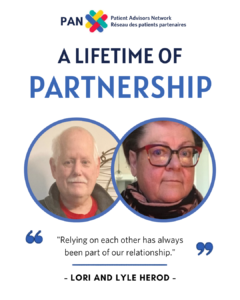
 Lori and Lyle met in 1976, when both were working with the Sea Cadets on the HCMCS Haida. It was the beginning of a fifty-year partnership. And throughout Lori’s career as a professor of adult education, Lyle’s 40 years in the Canadian military, and the raising of their son, it was their willingness and ability to support each that makes that partnership work.
As Lyle said, “relying on each other has always been part of our relationship.”
When Lyle had his stroke, he relied on Lori a great deal, and when Lori went in to the hospital the roles reversed. They have always taken turns supporting each other, and who supports who depends on the circumstances at the time. Their willingness to support each other, and others, is also what led them to become patient partners.
For their great work as patient partners, and their wonderful example of support, not just of each other, but of others and their communities, we are featuring Lori and Lyle Herod in this month’s PAN Spotlight.
Lori’s Story
Dr. Lori Herod’s patient partner journey began before Lyle’s. She is a survivor of complex relational trauma (CRT), and lives with Complex Post Traumatic Stress Disorder (CPTSD), which is not well known in medical or mental health circles. In fact, most survivors of CRT were abused/neglected in childhood and never received treatment, despite the fact that this type of trauma has well-documented negative effects on mental and physical health. When Lori realized how little help and information was available for CRT survivors, she decided to apply her skills and experience as a professor of adult education to making things better.
“There was very little support at the beginning, and not many folks know how to get into the system,” remembers Lori. “I had to start from scratch, educating the medical community about CPTSD, and figure out how to bring this type of patient partnering to the public eye and medical community.”
In 2014 she started the “Out of the Storm” website (https://www.outofthestorm.website) for English-speaking survivors of CRT worldwide, with a goal of educating both CRT survivors and members of the medical community. Lori’s work aims to reduce the stigma, shame, and silence surrounding this trauma, and promote understanding, knowledge and compassion for so many who have been left to fend for themselves.
That site now has more than 14,500 members from 86 countries, and Lori is now a dedicated advocate for trauma patients, focusing on their healthcare needs and promoting awareness of CRT/CPTSD, and enabling those who need anonymity to maintain it while still being able to reach out and help others.
It was this desire to help the community that led Lori to PAN. The national nature of the organization helps her reach out to CPTSD patients and medical practitioners across the country.
In what is somewhat unique for patient partners, Lori herself developed a project about a common complaint from members of Out of the Storm regarding a lack of access to healthcare professionals who know about CRT and CPTSD. She brought together a project team involving Co-Lead Dr. Colette Smart and other clinicians and patient partners. The research study part of the project, “Closing the Gap in Health Care,” confirmed a lack of professional education about CRT/CPTSD which leads to ineffective treatment, misdiagnoses and a lack of trauma informed care (TIC). An article about their findings has been submitted for publication, and the team also developed a guide for healthcare institutions and professionals in which patients’ voices are emphasized. Thus far, the guide has been disseminated to 45 medical and mental health organizations and associations in Canada and the United States. With Dr. Smart, Lori has also given presentations and interviews to raise awareness of CRT and CPTSD interviews.
Information about the study and the guide may be found at the OOTS website [https://www.outofthestorm.website/healthcare-project].
In addition to the “Closing the Gap in Healthcare” project, Lori has also served as patient partner for several research studies having to do with complex trauma by the SMARTLab (Dr. Smart’s Psychology research lab) at the University of Victoria.
Lyle’s Story
While Lori’s patient partner journey began from a need to build better care and information for a community of people who needed it, Lyle’s journey began after receiving excellent care for a life-threatening medical event. In 2020, Lyle suffered a massive stroke that left him unable to use the right side of his body. He spent two weeks in the Calgary Foothills Hospital for intensive medical care, four months in inpatient care at the Dr. Fanning Neuro-Rehab Centre, and two months in outpatient care at the Calgary Peter Lougheed Hospital. His recovery took another year, and now he has regained 90% of the functionality he lost.
It a journey he wouldn’t have made without the support of medical professionals, of volunteers, and of his family, who stood by him and helped him through the recovery. And it was this support that inspired him to make a difference for fellow stroke patients, and to join PAN.
“Working with others patients and with medical practitioners is a chance to make things a little better by participating,” Lyle said. “It’s something that, if we all do it, everything improves.”
Lyle began volunteering as a patient spokesperson for Heart and Stroke Canada, doing media engagements. He also became a patient partner member of the Heart & Stroke Community Consultation and Review Panel (CCRP) for the Secondary Prevention of Stroke, helping develop the annual updates of The Canadian Stroke Best Practice Recommendations (CSBPR).
Lyle joined PAN as another way to help people. As part of a national organization Lyle can reach out and support more folks who need it, and to share information with local groups across the country. Equally important, working with PAN gives him the opportunity to learn about different views and see the different situations across Canada.
Lyle is currently involved in two patient centered, stroke rehabilitation studies. First, the University of Alberta’s Stroke 18-month ALIGN study, investigating whether patients’ needs regarding neurological rehabilitation outcomes for Stroke, TBI and SCI patients are being met. Second, the University of Calgary’s year-long Stroke PRO study to develop and evaluate a patient-centered electronic outcome assessment system for acute stroke trials.
In addition, Lyle volunteers at the Carewest Dr. Vernon Fanning Centre as a peer support person for stroke patients 2-3 times per week, listening to patient concerns, talking about his own experiences, and being a friendly encouraging face to help patients through a frightening, lonely time. Lyle is also involved in local stroke support groups such as the Stroke Recovery Awareness of Calgary (SRAC) and the Calgary Aphasia Society. He also volunteers with a dozen other non-medical organizations in Southern Alberta.
A Rewarding Experience
Patient partnering, both through their own outreach and through their work with PAN, is something that Lyle and Lori have found rewarding, and something they encourage others to do.
“Patient partnering is a way to spread the word, and plant the seeds of change,” Lori said. “Check for patient-oriented research in your province, and find out how you can get involved. It can make a difference for folks, and that is awesome.”
She encourages those interested in Patient partnering to check out both the Patient Advisors Network (https://www.patientadvisors.ca) and the PxP (https://pxphub.org) websites, to learn what patient partnering is about, and what opportunities are available.
“The medical community involving patients is something new, and it is very encouraging,” Lyle said. “It brings a different element to medical care, and more focus on the patient as a person. Become a patient partner. Reach out, find an organization, and become a patient partner.”